 Book now
A short history of the Bodleian Library, from Duke Humfrey to the Weston
A medieval gift, a library emptied and left to the doctors, a diplomat who brought it back in 1602, and four centuries of building around the same rooms.
Most great libraries grow steadily from a founding. The Bodleian has two foundings, a collapse between them, and a habit of building upwards and outwards around the same few rooms. Knowing the story turns the 60-minute tour from four handsome interiors into a sequence that makes sense: the hall built for teaching, the room above it built for books, the man who rescued it, and the extensions that each generation added. This guide tells that story in order, with the dates you will hear on the tour.
Before the Bodleian: a room at St Mary's
Oxford's University was teaching long before it had a proper library. Its first purpose-built library was begun in about 1320 in the University Church of St Mary the Virgin on the High Street, in a room that still exists as a vestry and meeting room. It stood at the heart of the academic quarter, close to the schools where lectures were given.
Books then were rare and costly, copied by hand, and a small collection could fill a room. That changed with one patron.
Duke Humfrey's gift
Humfrey, Duke of Gloucester, was a younger brother of King Henry V and a serious collector of books. He gave the University his collection of more than 281 manuscripts, including several important classical texts. The gift was far too large for the room at St Mary's.
The University decided to build a new library for the manuscripts on top of the Divinity School, which was then still being built. Work on the library began in 1478 and it opened in 1488. The room is still known as Duke Humfrey's Library, and it is the oldest part of the Bodleian you can stand in today.
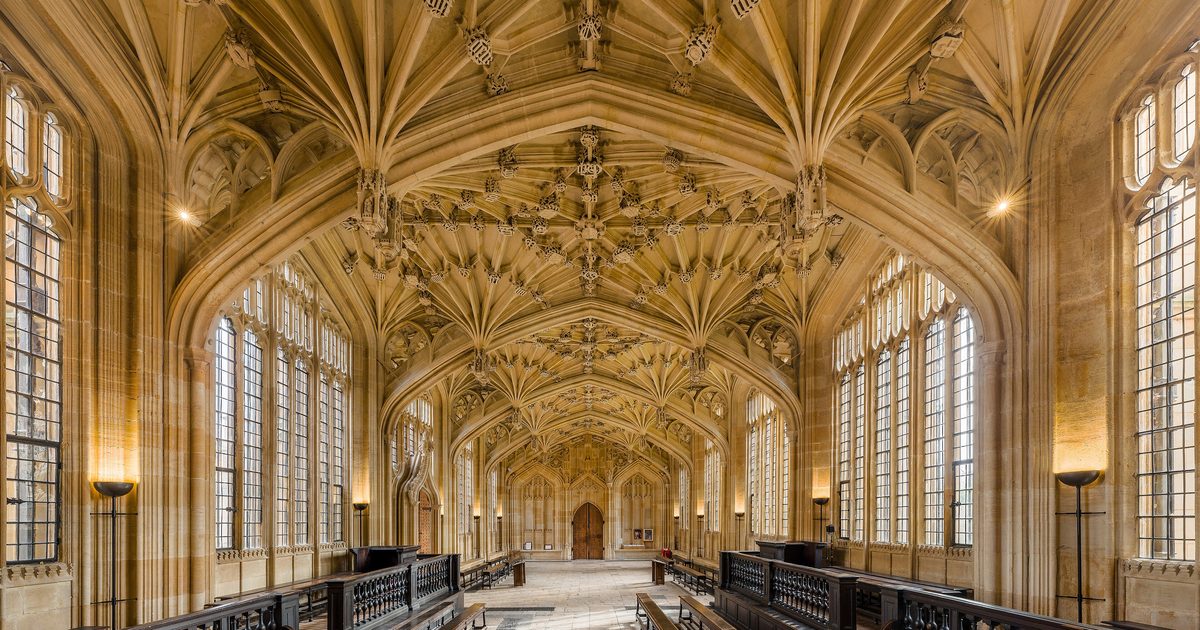
Below it, the Divinity School had been under construction since 1424 and was finished in 1488 too. The library calls it a masterpiece of English Gothic architecture: the University's oldest teaching room and first examination school, with a stone ceiling carved with over 400 crests and other images.
Emptied in 1550
Duke Humfrey's Library lasted only about sixty years in its first form. In 1550 the Dean of Christ Church, intent on removing what reformers called superstitious books and images, had all of the library's books taken away, some of them to be burnt.
The University was not rich, and it had no means to rebuild a collection. In 1556 the empty room was handed to the Faculty of Medicine. For the next forty years Oxford had a fine Gothic hall with a library-shaped room above it and almost no books to put in it. Only a few of Humfrey's original volumes are back in the collection today.
Thomas Bodley and 8 November 1602
The rescue came from Sir Thomas Bodley (1545–1613), a Fellow of Merton College who had served as a diplomat at the court of Elizabeth I. In retirement, and with the means that came from his marriage to a wealthy widow, he wrote that he would set up his staff at the library door in Oxford and restore the ruined room to public use for students.
From 1598 the old library was refurbished to take a new collection of around 2,500 books, some of them Bodley's own. Thomas James was appointed librarian, and the library opened on 8 November 1602. It is from that day that the Bodleian counts its continuous history, and it is Bodley's name that it carries.
Bodley thought about growth from the start. In 1610 he reached an agreement with the Stationers' Company of London under which a copy of every book registered at Stationers' Hall would be deposited in his library. It made the Bodleian the forerunner of a legal deposit library, and it guaranteed that the shelves would keep filling. Francis Bacon, giving the library a book in 1605, called it an ark to save learning from deluge.
Building outwards: Arts End, the Schools, Selden End
The new deposits soon needed space. In 1610–12 Bodley planned and paid for the first extension to the medieval room, known as Arts End, built above the Proscholium at the east end.
Bodley died in 1613, just as work began on his larger plan, the Schools Quadrangle. Its three floors were designed to give the University new lecture and examination rooms, the schools, in place of what he called those ruinous little rooms. In his will he left money for a third floor to store books, which also became a public museum and picture gallery, the first in England. The quadrangle was structurally complete by 1619, with work continuing until about 1624. Its tower, the Tower of the Five Orders, displays the five classical orders of columns one above the other.
The last of the old extensions came in 1634–37, at the west end of Duke Humfrey's. It is still called Selden End, after the lawyer John Selden, who gave the library 8,000 books. Beneath it sits Convocation House, the parliament house where the University's governing bodies met, and beside that Chancellor's Court with its oak-panelled dock of the 1630s. Together they complete the cluster of rooms that the 60-minute tour walks through.
A collection that reached far beyond Oxford
Bodley's ambitions were not parochial. Within a year of the opening he was trying to obtain manuscripts from Turkey, and in 1603 the library acquired its first Chinese book, at a time when nobody in Oxford could read it. By 1620 the collection had reached some 16,000 items, and anyone who wanted to use it had to buy a copy of the printed catalogue.
It was these gifts and purchases, especially of manuscripts, that drew scholars from across Europe, and the library still opens its doors to researchers from around the world. Until the British Museum was established in 1753, the Bodleian served in effect as the national library of England.
The Schools Quadrangle had its own moments. In 1769 the astronomer Thomas Hornsby observed the transit of Venus from the Tower of the Five Orders, the gate tower you pass on your way into the quadrangle.
The readers' promise
One tradition outlasts almost everything else. Before they are admitted, new readers must agree to a formal declaration. It was once always spoken aloud as an oath, and external readers still recite it; most now sign a letter to the same effect. Among other things, readers promise not to remove, mark or damage any volume, and not to bring any fire or flame into the library.
The ban on flame dates from the centuries when the library was unheated because fire was too great a danger to the books. The library keeps translations of the declaration in more than a hundred languages, so readers from anywhere can make the promise in their own tongue. Visitors on a tour do not take it, but the quiet you are asked to keep in Duke Humfrey's is the same courtesy the declaration asks of every reader.
A library that lent nothing
From the beginning the Bodleian was a reference library: books were read where they were kept. The rule was guarded so firmly that in 1645 even King Charles I, then holding court in Oxford during the Civil War, was refused permission to borrow a book. Historically the books in Duke Humfrey's were chained to the shelves, and to this day they can only be consulted in the Bodleian's reading rooms.
Reading there was not comfortable. The library had no heating until 1845 and no artificial lighting until 1929. In 1831 there were on average only three or four readers a day, and the library opened from 10am to 3pm in winter and 9am to 4pm in summer. When you stand in Duke Humfrey's on the tour, imagine it in a January afternoon, with daylight fading by three.
The eighteenth and nineteenth centuries
Growth slowed in the early eighteenth century, while Oxford built new libraries around it. The grandest was paid for by John Radcliffe, a royal physician, who left money for a new library building and its endowment. The domed, circular building in Radcliffe Square, designed by James Gibbs, went up between 1737 and 1748 and opened in 1749. For many years it was entirely independent of the Bodleian.
The Bodleian's own collections picked up again through better agreements with the Stationers' Company, purchases and gifts. By 1849 it was estimated to hold 220,000 books and some 21,000 manuscripts, along with pictures, sculptures, coins and assorted curiosities, among them a stuffed crocodile from Jamaica. The upper rooms of the quadrangle were given over to the library by 1788, and by 1859 the whole Schools Quadrangle was in library hands.
In 1860 the Bodleian took over the Radcliffe Library and renamed it the Radcliffe Camera, camera being Latin for room. The two buildings, a minute's walk apart, have worked as one library ever since.
The twentieth century and the Weston Library
By the early twentieth century around a hundred people a day were using the library, and the collection passed a million books by 1914. To make room, an underground book store was dug beneath Radcliffe Square in 1909–12, the largest of its kind in the world at the time.
It was still not enough. In 1931 the University decided on a new building on the north side of Broad Street, designed by Sir Giles Gilbert Scott and built in 1937–40, known as the New Bodleian. In 1975 the library also took over the Clarendon Building, built in 1712–13 for the University Press, which stands between the old and new libraries. With that, the whole stretch from the Radcliffe Camera to the New Library, the historic core of the University, belonged to the Bodleian.
The New Bodleian was completely renovated and reopened as the Weston Library in 2015, with large public spaces on its ground floor. Today the Bodleian Libraries hold more than 13 million printed items, and the library has been a legal deposit library for 400 years. It is one of the oldest libraries in Europe and, in Britain, second in size only to the British Library.
Seeing the history on the tour
The 60-minute guided tour walks you through this story in physical form. You meet in the Proscholium, below Bodley's Arts End. You stand in the Divinity School, begun in 1424, under the vault that was finished as Humfrey's library rose above it. You pass into Convocation House and Chancellor's Court, the seventeenth-century rooms built beneath Selden End. And you finish upstairs in Duke Humfrey's Library itself, opened in 1488, emptied in 1550 and brought back by Bodley in 1602.
Tickets for the tour are released online at 9am UK time on the 1st and 15th of each month, and groups are limited to 14, with everyone aged 11 or over. If your date is not yet on sale, or has sold out, you can hold it with us at no cost until a place can be booked.
Frequently asked
When was the Bodleian Library founded?
It opened on 8 November 1602, refounded by Sir Thomas Bodley in the room built for Duke Humfrey's manuscripts, which first opened in 1488.
Who was Duke Humfrey?
Humfrey, Duke of Gloucester, a younger brother of Henry V, who gave the University more than 281 manuscripts.
Why is it called the Bodleian?
After Sir Thomas Bodley, who restored the library and reopened it in 1602.
Did the Bodleian lend books?
No. It was a reference library from the start, and in 1645 even Charles I was refused a loan.
How big is the Bodleian today?
The Bodleian Libraries hold more than 13 million printed items.